
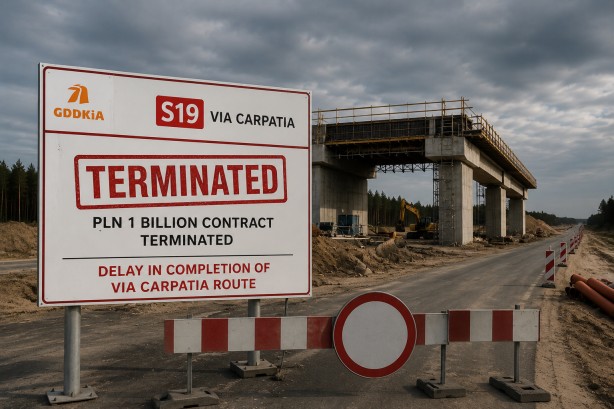
A crucial contract worth PLN 1 billion for constructing a segment of the S19 expressway in Poland’s Podkarpackie region has been terminated, halting progress on the Domaradz to Krosno stretch and leading to further delays on the Via Carpatia route. The General Directorate for National Roads and Motorways (GDDKiA) initially partnered with Mostostal Warszawa in November 2022 to complete the project by June 2026. However, by spring 2026, construction was significantly behind schedule with only about 5 percent finished.
Mostostal Warszawa informed GDDKiA in April of its decision to pull out of the agreement, citing unmet contractual obligations by the road authority and unresolved project challenges. According to the contractor, unforeseen ground conditions escalated costs by approximately PLN 150 million, while modifications mandated by environmental authorities could increase expenses by another PLN 400 million. GDDKiA disputed Mostostal’s claims, attributing the lack of progress to the contractor’s shortcomings, and formally ended the contract in May. The authority has since been securing the site and evaluating the work completed so far.
With the inventory now finalized, GDDKiA is anticipated to launch a new tender for completing the Domaradz–Krosno section, expected around late August to early September. The new contractor will be tasked with finishing the work within 26 to 28 months post-contract signing, adhering to the existing budget. Meanwhile, other sections of the Via Carpatia route in the Podkarpackie region are also experiencing setbacks. The timeline for the Babice–Jawornik portion has been extended to October 2027, while the Rzeszów Południe–Babice section, which includes a tunnel over 2.2 kilometers long, is now projected for completion in January 2028.
These delays are exacerbating the pressure on the development of Via Carpatia, a significant transport corridor aimed at enhancing connectivity between southeastern Poland and the broader European road network. The repeated postponements are raising concerns about meeting the strategic goals of the corridor, which is vital for regional development and integration into the European infrastructure grid.