
The Gulf’s tightly interconnected economy took fresh blows on Saturday as Iranian missiles struck Fujairah in the UAE, forcing a halt to oil-loading operations at one of the world’s most critical ship-refuelling hubs. Oil prices already hovering near $120 per barrel were pushed higher by the disruption, adding to the economic pain caused by Iran’s closure of the Strait of Hormuz since the war began on February 28. The strikes made clear that Iran’s strategy included using economic damage to neighbouring states as a lever against the United States.
Iran’s military threatened on Saturday to target any energy or infrastructure facility in the Gulf region with ties to American companies. The threat was accompanied by calls from Iran’s foreign minister for Arab states to expel US military forces, arguing that the American presence was what had drawn the conflict to the region. The UAE condemned the attack on Fujairah as terrorism while maintaining it was still seeking restraint and a diplomatic resolution. Gulf states found themselves in an increasingly difficult position as Iran’s strikes broadened and US military operations intensified.
US warplanes bombed Kharg Island on Saturday for the second day in a row. President Trump claimed US strikes had effectively demolished the facility — Iran’s main crude oil export terminal — and hinted at additional attacks. He also warned that Iran’s remaining oil infrastructure could be targeted if Tehran continued blocking the Strait of Hormuz. Trump called on China, France, Japan, South Korea, and the UK to contribute warships to a coalition to reopen the passage, in what observers described as an implicit admission the US might need multilateral support.
Israel was also conducting intensive air operations against Iran, striking targets across the country including Isfahan, where at least 15 people were killed in an airstrike on a factory. The Israeli military said it was systematically targeting Iran’s missile launch capacity and security forces. Iran continued to fire rockets at Israel and missiles at the UAE. US Defence Secretary Pete Hegseth described Iran’s leadership as “desperate and hiding” and claimed the new supreme leader had been wounded in an earlier Israeli strike, though Tehran disputed the severity of the injury.
The human cost of the conflict was vast and growing. More than 1,400 people had been reported killed in Iran under relentless bombing. Thirteen Israelis and roughly 20 Gulf residents had died. Lebanon was experiencing a parallel catastrophe, with more than 800 killed and 850,000 displaced from Israeli strikes on Hezbollah. The US embassy in Baghdad was struck overnight, and Americans were ordered to leave Iraq. Six US troops died when a military aircraft crashed in western Iraq. Analysts urged Trump to pursue a diplomatic exit before the conflict triggered a full-blown global economic crisis.
Iranian Missiles Wound Region’s Economy as Gulf States Feel the Heat of War
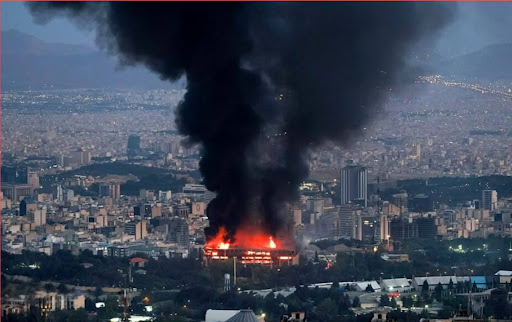
Photo by Mohammad Bornu / Avash Media / Wikimedia Commons (CC BY 4.0)
4